
May 31

Everyone’s Buying AI Sourcing Tools. Why Do Recruiters Still Feel Behind?

Shally Steckerl on stage at the ERE Recruiting Innovation Summit in Atlanta, smiling with one hand raised in a wave. He wears a dark shirt and jeans, with the summit podium beside him and a purple Atlanta skyline on the screen behind.

Every few years, the talent acquisition world latches onto a new magic bullet. Boolean search was going to fix everything. Then it was AI-powered sourcing tools. Then conversational AI. Then generative AI.


Here we are in 2026, and most sourcing functions are still underperforming — despite having more technology at their fingertips than ever before.


I've worked with thousands of recruiters and hundreds of organizations over three decades. I keep seeing the same pattern: teams buy tools to solve problems that tools can't solve. They automate broken processes and wonder why the output is still broken. They measure activity instead of outcomes and mistake volume for value.


This is the AI sourcing trap. And most of you are already in it.

It was never a tool problem.


TA leaders treat programmatic like a media buy. Throw budget at job ads, watch the dashboard fill with clicks, wonder why the reqs are still open. That isn't sourcing at scale. It's noise at scale. Fast noise wearing a progress costume.


Sourcers think one great candidate at a time. Craft, patience, precision. Brilliant, until you need fifty.

Machines scale. No judgment, no signal, just throughput.

Neither wins alone, anymore. 


Is automation the enemy? No. Automation without sourcing logic underneath it is.
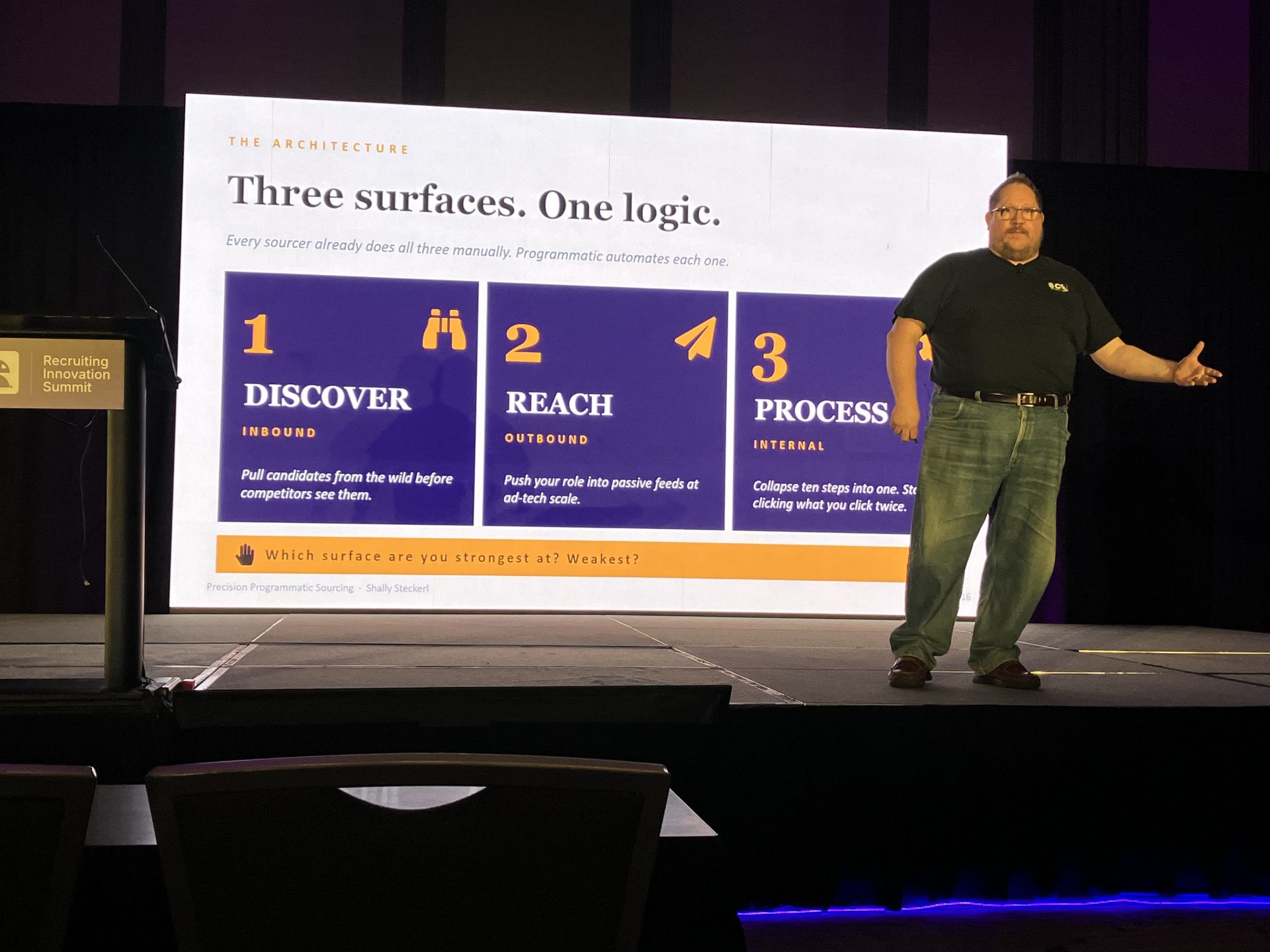
Shally Steckerl presenting at the ERE Recruiting Innovation Summit, arm extended toward a slide titled "Three surfaces. One logic." The slide shows the programmatic sourcing framework: 1 Discover (inbound), 2 Reach (outbound), 3 Process (internal), with the prompt "Which surface are you strongest at? Weakest?"

You Don't Have a Tool Problem

Let me be blunt: if your sourcing isn't working, the tool probably isn't the reason.

When an organization tells me their sourcing results are poor, I ask three questions:

1. Is this a process failure? Are candidates falling through cracks because handoffs are unclear, follow-up is inconsistent, or nobody owns the pipeline?
2. Is this a skill gap? Do your sourcers actually know how to research, engage, and qualify — or are they just running searches and blasting InMails?
3. Is this a strategy misalignment? Is sourcing solving for what the business actually needs, or is it optimizing for metrics that don't matter?

Nine times out of ten, the answer is one of these three — not "we need a better tool."

Yet the default response is always to buy something. A new AI sourcing platform. A Chrome extension. An automation workflow. And then six months later, the same problems persist with a newer, shinier interface around them.

The Specific Trap AI Is Setting Right Now

AI tools in sourcing are genuinely impressive. They can parse profiles faster, match skills more accurately, and generate outreach at scale. I'm not anti-AI — I've been in this space long enough to know that technology, used well, is transformative.

But here's what AI can't do:

  1. It can't fix a bad sourcing strategy. If you're targeting the wrong talent pools or using the wrong engagement approach, AI will help you do the wrong thing faster.
  2. It can't replace human judgment on fit. Matching keywords to job descriptions is not sourcing. Understanding a candidate's motivations, career trajectory, and cultural alignment requires human intelligence that no model can replicate.
  3. It can't compensate for broken handoffs. If your recruiter-sourcer relationship is dysfunctional, automating the sourcer's output won't help.

The trap is this: AI makes it feel like you're doing more. More candidates surfaced. More outreach sent. More data collected. But "more" is an output metric. What matters is the outcome: quality hires, faster fills, better retention, lower cost.

If you're measuring outputs and calling it success, AI is helping you fool yourself more efficiently.

Diagnose Before You Prescribe

Before you buy another tool or bolt on another AI feature, run a 15-minute diagnostic on your sourcing function:

Step 1: Map the Actual Workflow

Not the process document — the *actual* workflow. Where do candidates really come from? What happens after a sourcer surfaces a name? How long does it take to get from identified to contacted to screened? Where do people drop off?

Most teams have never done this honestly. When they do, the bottlenecks become obvious — and they're almost never where the technology sits.

Step 2: Check Your Metrics

Are you measuring:
  • Outputs? Candidates sourced, InMails sent, searches run, profiles viewed.
  • Outcomes? Hires from sourced candidates, time-to-fill for sourced roles, quality-of-hire, offer acceptance rate.

If your dashboard is all outputs, you're flying blind. You might have the most active sourcing team in the industry and still be underperforming on the metrics that actually matter.

Step 3: Locate the Constraint

Your sourcing function has one primary bottleneck at any given time. Find it. Is it:
  • Top of funnel? Not enough qualified candidates being identified.
  • Engagement? Candidates identified but not responding.
  • Conversion? Candidates engaged but not progressing.
  • Handoff? Sourced candidates dying in the recruiter's pipeline.

Each of these requires a completely different intervention. A new AI tool might help with one of them. But if you don't know which one is your constraint, you're guessing — and expensive guessing at that.

Fix Systems, Not People

When sourcing underperforms, the instinct is to blame the sourcers. They're not working hard enough. They don't know the right techniques. They need more training.

Sometimes that's true. But more often, the system around them is the problem.

I've seen elite sourcers produce mediocre results in broken systems, and average sourcers produce excellent results in well-designed ones. The system — the process, the tools, the handoffs, the feedback loops, the metrics — determines the ceiling.

If you blame people for system failures, you'll keep cycling through headcount and never fix the root cause. If you fix the system, you lift everyone's performance.

This is a leadership problem, not a sourcing problem.
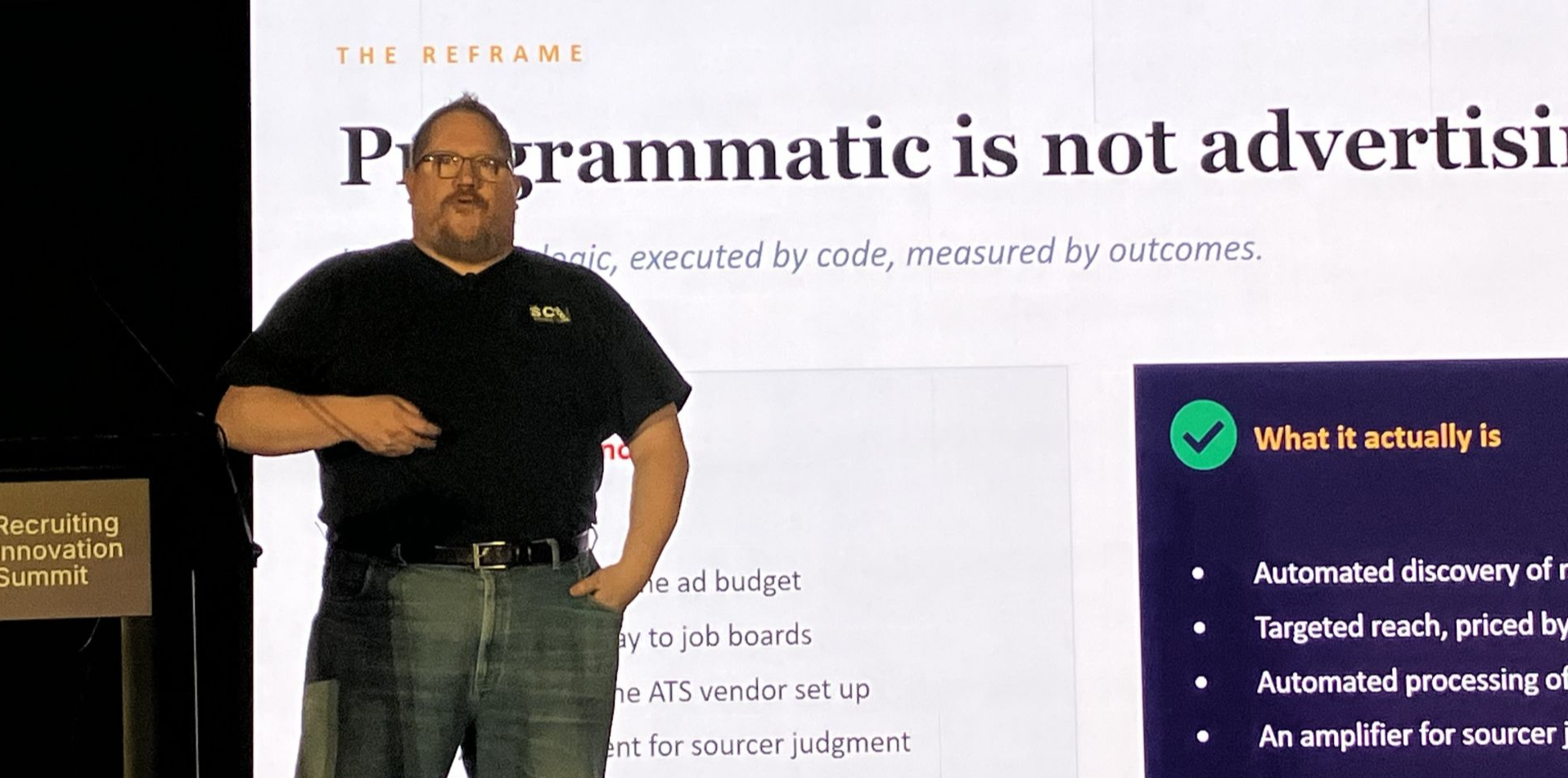
Shally Steckerl speaking at the ERE Recruiting Innovation Summit in front of a slide reading "Programmatic is not advertising. It's sourcing logic, executed by code, measured by outcomes," next to a panel listing what programmatic sourcing actually is.
Where AI Actually Belongs

After all that, let me be clear about where AI earns its place in the sourcing stack:

1. Research acceleration. AI is excellent at synthesizing information from multiple sources quickly. Use it to build richer candidate profiles, not to replace research entirely.
2. Pattern recognition. AI can surface non-obvious candidate pools based on skills adjacency, career path analysis, and market mapping. This is genuinely valuable when the human guides the strategy.
3. Outreach personalization at scale. AI-generated first drafts of personalized outreach, reviewed and refined by a human, can dramatically improve response rates. AI-generated outreach sent without human review will destroy your employer brand.
4. Pipeline analytics. AI-powered dashboards that connect sourcing activity to hiring outcomes — not just outputs — can finally give leaders visibility into what's working.

Notice the pattern: AI works best as an accelerant for human-driven strategy. It fails when it replaces strategy entirely.

What You Do Differently on Monday Morning

If any of this resonated, here's what I'd do this week:

1. Run the 15-minute diagnostic. Map your actual workflow. Check your metrics. Find the bottleneck.
2. Audit your tool stack against your actual bottleneck. Are your tools solving the problem you actually have, or a different one?
3. Have the hard conversation about metrics. If your team is reporting outputs, start the transition to outcomes. It'll be uncomfortable, but it's the only way to know if sourcing is actually working.
4. Stop buying for six months. If you're about to purchase a new sourcing tool, pause. Fix the underlying process first. Then evaluate whether the tool addresses the real problem.

The organizations that win at sourcing in 2026 won't be the ones with the most AI tools. They'll be the ones with the clearest strategy, the most honest diagnostics, and the discipline to fix systems before adding technology.

The AI sourcing trap is seductive because it looks like progress. Don't fall for it.
Empty space, drag to resize
Shally Steckerl is the founder of The Sourcing Institute and a principal at Riviera Advisors. He has trained over 30,000 recruiters and has been a practitioner in talent sourcing since 1996. He spoke on this topic at the ERE Recruiting Innovation Summit in Atlanta, May 2026.