A new study found that people stripped of their background knowledge solved problems no better than a random number generator.
Even when they could watch the winners do it right in front of them. Now read that again, slowly, and picture your team using AI to source.
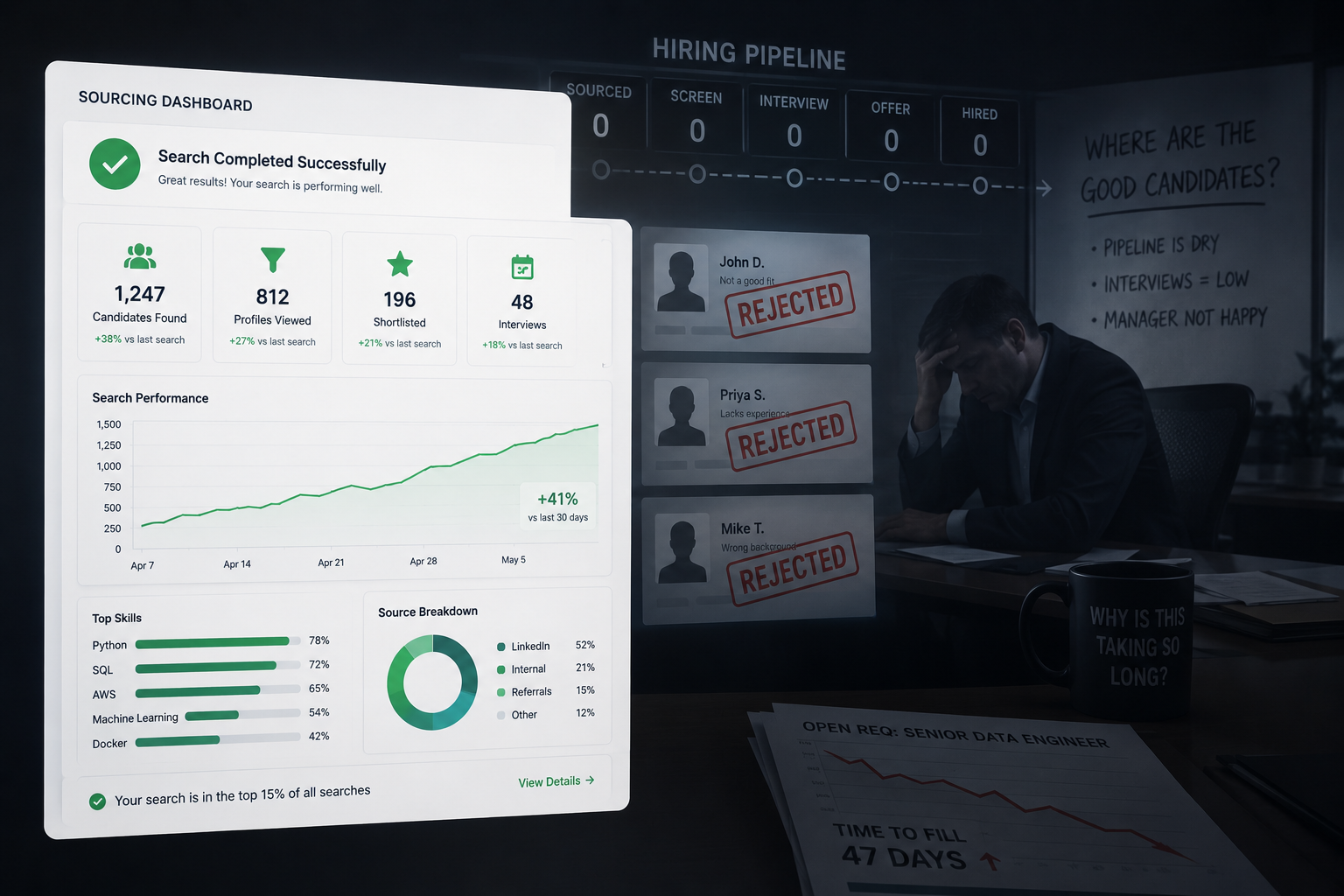
Half the people bragging about their AI sourcing stack got worse this year. They have no idea, because the tool is very good at hiding the bodies.
The invoice doesn't arrive when you run the search. It shows up weeks later, when the pipeline is thin and the hiring manager wants to know why.
Empty space, drag to resize
Lets compare two searches side by side. One you copied off ChatGPT, one you built from scratch through your own read of the market.
They look very similar on screen.
But they are not the same thing, and the distance between them is the whole difference between a true sourcer and someone cosplaying as one. You just can't tell which one you are holding until the results come back.
Karolinska ran the experiment. Over 1,200 people, a game where the entire point was to combine things into something useful. One group worked with real objects they understood. The other got meaningless symbols. The group without meaning did not merely do worse. They performed at chance. Equal to a coin flip. A random number generator in a chair.
Then the researchers did the cruel, clarifying thing. They let the clueless group watch skilled people solve it correctly, in real time, right in front of them. It changed nothing.
You cannot copy your way into understanding you do not have. Watching a master does not transfer mastery. It never has.
The people who had real knowledge AND could learn from others produced roughly double the output of everyone else. Knowledge was the multiplier. The tool was just the tool.
Stop. Go back. Read that as many times as you need to, because your entire AI budget is built on the opposite being true.
The only question that matters is: do you carry a map of your talent universe, or a library of tactics you borrowed and never understood?
There is a way to find out. Hand two recruiters the same req and watch.
The library recruiter:
- Pastes the title into the search bar
- Asks AI for "a Boolean string for this role"
- Runs whatever comes back, takes whatever it returns
- Cannot tell you why it worked or why it didn't
- When it returns junk, asks AI to "make it better"
The map recruiter:
- Reads the req and instantly knows three titles that mean the same thing and two that look similar but are not
- Knows the four companies that actually grow this skill and the two that only claim to
- Knows the one adjacent skill that proves the person is the real thing
- Uses AI to move faster across that map, not to replace it
- When the string returns junk, knows exactly which assumption was wrong
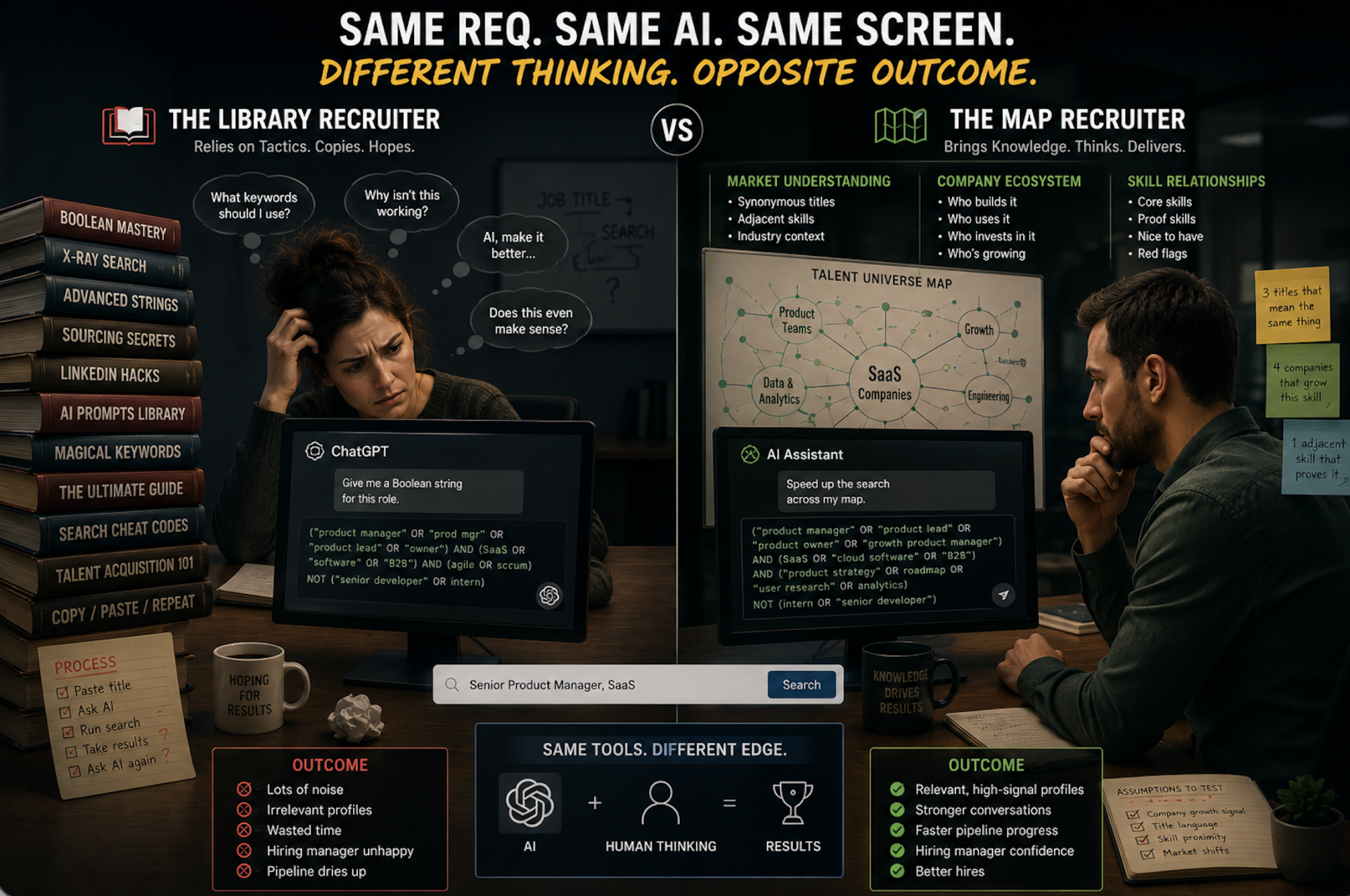
Same req. Same AI. Same screen. Opposite human behind it, opposite outcome.
And do not sit there feeling safe because you have twenty years in. That study's next question is whether deep expertise blinds you, whether decades of "this is how it's done" makes you skip the strange move that would have worked. I catch myself doing it more than I care to admit. The map is power right up to the moment it becomes a cage, and the most experienced person in the room is usually the last to hear the door lock behind them.
Squirming in your seat yet? Good. The tool was never the thing holding you back, and no upgrade is coming to save you.
Save this for the next person who tells you AI killed the need to know your craft.
Empty space, drag to resize
Source: PNAS (Yaman, Tian, Lindström, "Semantic knowledge guides innovation and drives cultural evolution") in the first comment, not the body, so the post stays clean and people have a reason to expand it.